


Interview with Simon Hunt, Dubai — December 2025
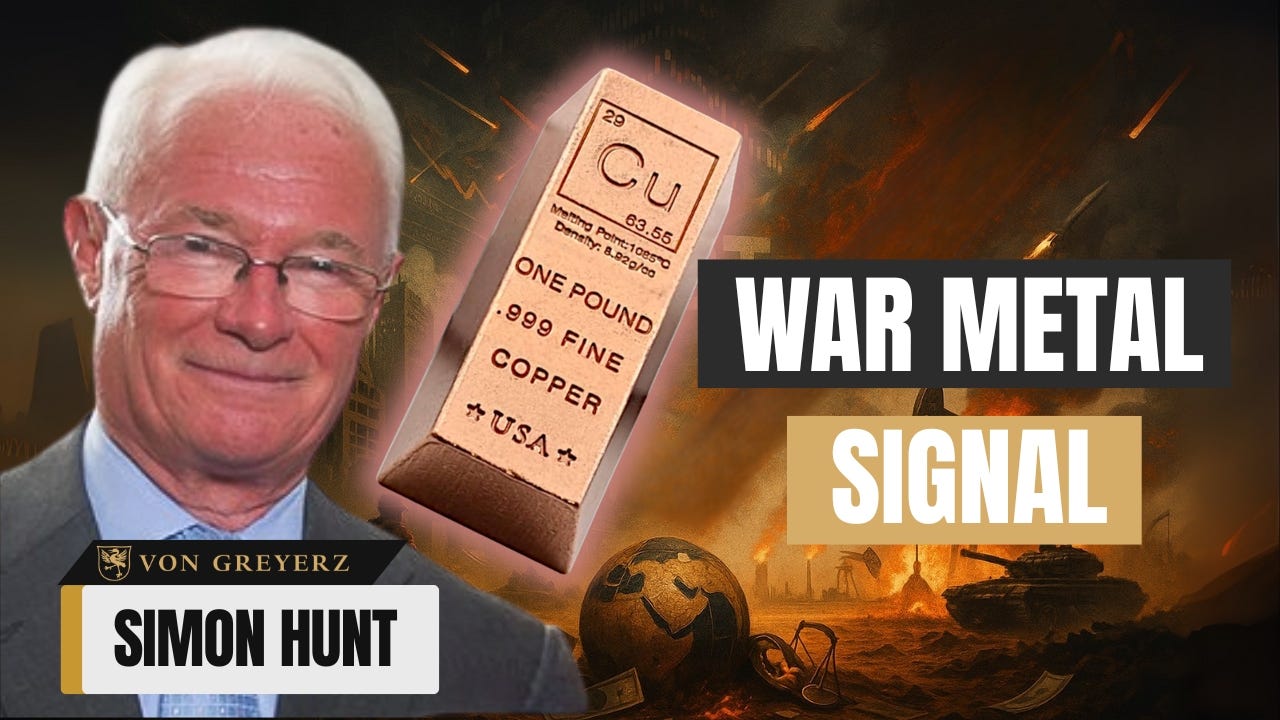
Copper is often described as a barometer of global growth.
But in today’s world, it may be something darker — a barometer of conflict.
From bond markets to battlefields, copper links the global economy, monetary policy, and modern warfare. While investors focus on future demand from data centers and green grids, Simon Hunt sees a different story unfolding beneath the surface: slowing growth, rising interest rates, overstretched markets — and a world quietly preparing for prolonged geopolitical tension.
In this interview, Jan Baltensweiler - VON GREYERZ (English) speaks with Simon Hunt, founder of Simon Hunt Strategic Services, about why copper is flashing warning signals not just about markets, but about the war economy taking shape.
Background and Analytical Framework
Jan Baltensweiler:
For readers who may not know you, could you briefly outline your background and your analytical approach?
Simon Hunt:
I have been involved in forecasting the copper industry since 1975. I began my career working in the copper sector in Southern Africa, before moving to London to work at Anglo American. I later gained experience in financial markets in the City of London and went on to found Brook Hunt Associates, which I ran for 20 years. Today, I lead Simon Hunt Strategic Services.
“My work always starts with copper, but copper itself is never the whole story. To understand it properly, you have to assess the entire global economy — geopolitics, interest rates, inflation, bond markets, and financial confidence. Copper is the end result of those forces interacting.”
Copper as an Economic Signal
Jan Baltensweiler:
The relationship between gold and copper is often discussed. What is it telling us today?
Simon Hunt:
The relationship between gold and copper is an important macro signal. Over the past year, the gold-to-copper ratio has fallen sharply. Analysts who track this ratio see it as a warning that the global economy is facing increasing headwinds.
In practical terms, this suggests that copper consumption is unlikely to accelerate. At best, demand may remain flat; at worst, it may decline over the next nine months.
“The gold–copper ratio is not confirming the growth optimism in markets. It is signalling that the global economy is running into headwinds.”
This stands in contrast to the highly optimistic expectations currently embedded in copper-related narratives.
Normal Slowdown or Structural Crisis?
Jan Baltensweiler:
Are we facing a normal economic slowdown, or something more serious?
Simon Hunt:
That is the key question. If this is merely a cyclical slowdown, the implications are manageable. If it is more than that, the consequences for markets — and for copper — are far more severe.
In my view, we are entering a sequence of escalating crises. We have already seen the beginnings of a mini-crisis in equity markets, which is likely to extend into early January. That is likely to be followed by a much larger crisis in the second quarter of next year.
“The most severe phase is likely to occur in 2027–2028, when confidence breaks down and equity markets fall to levels that are extremely difficult to contemplate today.”
This is not a single event, but a process.
The Role of Bond Markets
Jan Baltensweiler:
What is driving this outlook?
Simon Hunt:
Bond markets are central. Bond investors — the so-called bond vigilantes — will demand real returns on their capital.
With inflation running above 8%, that implies that 10-year U.S. Treasury yields could move into double-digit territory by the second half of 2027. A move of that magnitude would have profound implications.
“If bond investors insist on real returns in an 8% inflation world, you are looking at double-digit yields on 10-year Treasuries. That would be profoundly disruptive for risk assets.”
Over the next two to three years, markets are therefore likely to be extremely volatile, with sharp rallies followed by sharp declines. Each crisis may generate a temporary recovery, but the overall process points toward a much more serious breakdown later in the decade — something that could resemble a depression.
Policy Risk
Jan Baltensweiler:
In that context, what is the biggest mistake policymakers could make next?
Simon Hunt:
Cutting interest rates.
“The biggest policy mistake now would be to cut rates.
It would store up even larger problems for later.”
Copper and the Reality of War
Jan Baltensweiler:
Copper is increasingly discussed in a geopolitical and military context. Why is that?
Simon Hunt:
Copper is indispensable to modern warfare. It is used in ammunition, tanks, naval vessels, fighter aircraft, drones, missiles, communications systems, and the supporting electrical infrastructure.
Approximately 12% of global copper consumption today is already related to military requirements.
“The largest consumers of copper for military purposes are not the United States, but Russia and China, followed by the U.S.
That tells you something about where strategic preparations are being made.”
This is why copper must increasingly be viewed not just as an industrial metal, but as a strategic resource at the heart of a slowly emerging war economy.
Are Copper Prices Misaligned?
Jan Baltensweiler:
How do you assess current copper price levels?
Simon Hunt:
The market today is driven largely by optimism around future demand from data centers and the upgrading of electrical grids globally. However, many analysts are too optimistic about the timing of that demand.
It has not yet appeared in the order books of fabricators, but the market has already priced it in.
“At current levels, around 11,500, copper prices look far too optimistic given the economic and geopolitical backdrop.”
Given that the global economy is unlikely to accelerate over the next six to nine months, a significant correction in copper prices is, in my view, highly likely.
Closing Perspective for Investors
Copper has always reflected the health of the global economy. Today, it is also reflecting the state of geopolitics, capital markets, and military preparedness.
For high-net-worth and institutional investors, the message is less about trading the next move in the copper price, and more about risk, timing, and capital preservation in a world where financial and geopolitical cycles are increasingly intertwined.
“In this environment, copper is not confirming optimism.
It is signalling stress — economic, financial, and geopolitical.”
That signal should not be ignored.
Jan Baltensweiler, jan.baltensweiler@vongreyerz.gold, +41 44 213 62 45
VON GREYERZ (English) has earned the trust of HNWIs and investors in over 90 countries, specializing in the secure, fully segregated, unhypothecated, unencumbered, and insured storage of physical gold—entirely outside the banking system.
Thanks for this new point of view that I haven't heard so far. I have a more optimistic outlook on it, but I could very well be wrong